


Taiwan Semiconductor raised 2026 capex to $60–64 billion and chip stocks sold off again. Netflix fell 9% after guidance disappointed. Brent held near $85 after a fifth night of U.S. strikes on Iran. Bitcoin traded near $64,700 as the GENIUS Act deadline arrives Saturday.
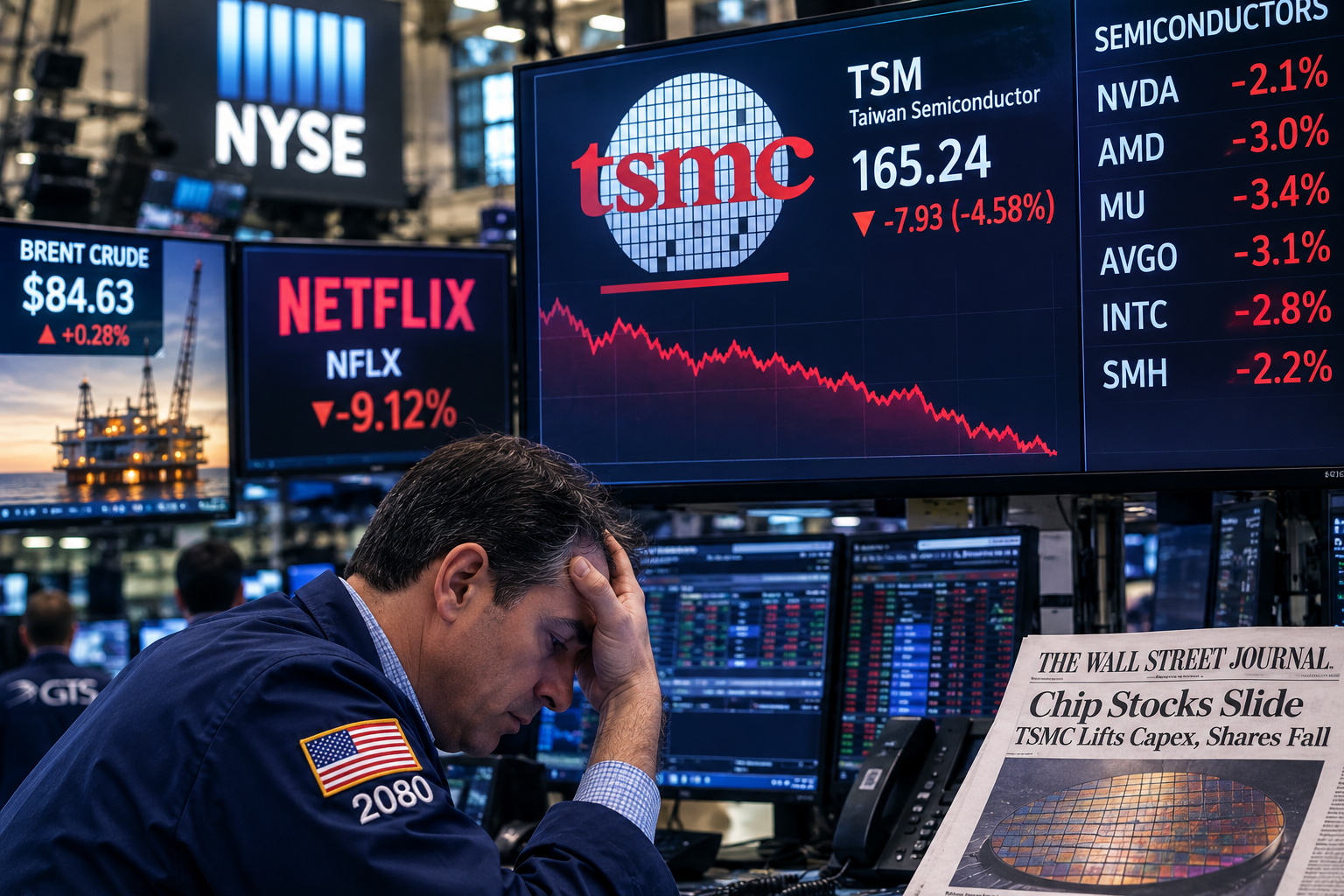
Friday opens with the AI trade questioning its own economics.
Taiwan Semiconductor (TSM) reported a 77% jump in quarterly profit to about $22.4 billion but raised its 2026 capital spending forecast to $60 billion to $64 billion from $52 billion to $56 billion. Investors sold the news. Shares fell 4.6% as higher spending reinforced the view that AI infrastructure costs continue to climb.
The VanEck Semiconductor ETF (SMH) fell 2.2%. Intel (INTC) lost 2.8%. Micron (MU), AMD (AMD), SanDisk, and Broadcom (AVGO) each dropped about 3%.
The broader market held up better. UnitedHealth (UNH) jumped 7% after beating estimates and raising guidance, helping keep the Dow near flat. IBM (IBM), Goldman Sachs (GS), and Cisco (CSCO) were the Dow's biggest laggards. The S&P 500 slipped 0.3% while the Nasdaq 100 lost more than 1%.
Asia extended the move. South Korea's Kospi fell 5.1% as SK Hynix (SKHY) dropped 9% and Samsung lost 5.3%. Japan's Nikkei fell 2.4%. Regulators are now reviewing the leveraged ETF activity that amplified recent swings.
Three catalysts remain this week: today's housing and industrial production data, Saturday's GENIUS Act stablecoin deadline, and the run into Alphabet (GOOGL) and Tesla (TSLA) earnings on July 22 ahead of the July 29-30 FOMC meeting.
The Signal
Strong earnings are no longer enough. Markets are rewarding cash flow and punishing rising AI spending.
There's a Strategy Behind the Iran War.
I know because I've seen the evidence firsthand.
On March 2nd — three days after the first missiles hit — I sat across from two U.S. Congressmen in back-to-back private meetings.
Those meetings pointed me toward something I spent weeks verifying.
The real purpose behind the strikes. The real objective. And the single company at the dead center of all of it.
This isn't random. It's a calculated Two-Front Economic War.
And there's one company positioned right at the heart of it.
See the strategy behind the Iran war — and the company at the center of it
The sooner you understand what's really happening — the better positioned you'll be before August 12th.
— Dylan Jovine, Founder, Behind the Markets
The war and oil are no longer moving together.
U.S. Central Command struck Iranian military targets for a fifth straight night, targeting capabilities linked to attacks on shipping through the Strait of Hormuz. Kuwait also intercepted hostile drones.
Brent settled near $84.63, little changed on the day but still about 20% above pre-war levels. Traders are now watching reports that Washington is weighing strikes on Iran's Kharg Island export terminal.
The market has stopped reacting to ceasefire headlines. It is reacting to whether export infrastructure becomes the target.
Energy Signal
Five straight nights of strikes barely moved oil. Markets have priced a managed conflict, not a disruption to Kharg Island exports.
Rates are carrying the hawkish story forward.
The 10-year Treasury yield climbed to 4.60%, close to last week's two-month high of 4.62%. Freddie Mac's 30-year mortgage rate reached 6.55%, the highest level in nearly a year.
Retail sales rose 0.2% in June, slightly below expectations, largely because gasoline receipts declined. Jobless claims fell to their lowest level in more than two months.
The message remains the same. Consumers are slowing only modestly while the labor market stays firm.
Today's calendar includes preliminary July Michigan sentiment, housing starts, building permits, and industrial production.
Macro Signal
Higher oil, higher yields, and a resilient labor market continue pushing the Fed toward a cautious stance ahead of July 29-30.
Satellite Confirms: Elon Musk Activating Strange 'Dark Energy' Across U.S. South

Confirmed by satellites 300 miles above the Earth's surface... Elon Musk is rolling out a breakthrough technology that could replace our need for foreign oil and ignite a $10 trillion boom a small group of stocks. Click here to learn how you can invest in this before it becomes mainstream.
Earnings season is rewarding clarity.
Taiwan Semiconductor's capex increase pulled the entire chip sector lower and helped push SpaceX below its $135 IPO price for the first time. Shares now trade roughly one-third below their post-IPO high as investors prepare for up to 911 million insider shares to unlock over coming weeks.
Netflix (NFLX) fell 9% after hours despite beating earnings expectations. Investors focused on weaker guidance and the company's decision to stop reporting subscriber numbers, making future growth harder to judge.
Uber (UBER) gained 3% after agreeing to acquire Delivery Hero for $14.8 billion, expanding its global delivery footprint.
Today's earnings include Truist (TFC), Fifth Third Bancorp (FITB), and Travelers (TRV).
Capital Signal
Markets want more transparency, not less. Guidance now matters more than the quarter that just ended.
Bitcoin is steady. Ether continues leading.
Bitcoin traded near $64,700, up 4.2% for the week. Ether climbed 11% over the past seven sessions to around $1,920 as Japan's crypto tax changes and growing layer-2 activity boosted demand.
Robinhood Chain is processing more than $800 million in daily volume, adding structural demand for Ethereum.
Spot Bitcoin ETFs added about $191 million over the last two sessions after a 10-day, $2.73 billion outflow streak. Even so, the Crypto Fear & Greed Index remains at 26. Citigroup lowered its 12-month Bitcoin target to $82,000 from $112,000 because ETF flows remain unstable.
Saturday brings the GENIUS Act stablecoin deadline. None of the six agencies responsible for the rules has released final guidance. Today is effectively the last business day before issuers enter a legal gray area.
Strategy (MSTR) has not purchased Bitcoin since June 22. It now holds 843,775 BTC while building a $3 billion cash reserve and maintaining a $2 billion buyback authorization.
The Verdict
Ether has found new demand drivers. Bitcoin is waiting for regulatory clarity. Both depend more on Washington than crypto this week.
Buffett, Gates and Bezos Quietly Dumping Stocks—Here's Why

The world's wealthiest individuals are making huge moves with their money.
Warren Buffett just liquidated billions of shares. Bill Gates sold 500,000 shares of Microsoft. Jeff Bezos filed to sell Amazon shares worth $4.8 billion.
What is going on? One multi-millionaire believes they are preparing for a catastrophic event. But not a crash, bank run, or recession. It’s something we haven’t seen in America for more than a century.
This week showed that good news can still produce bad price action.
Taiwan Semiconductor beat expectations and sold off because spending increased. UnitedHealth beat and rallied. Netflix beat but lost 9% because investors questioned future visibility.
Iran has now faced five straight nights of U.S. strikes, yet oil has stabilized. That changes only if export infrastructure like Kharg Island becomes the target.
Saturday's GENIUS Act deadline could finally give stablecoin issuers regulatory clarity, or leave the industry operating without final rules.
Next week shifts attention to Alphabet and Tesla earnings, the ECB decision, and the July 29-30 FOMC meeting.
The question is no longer whether the economy is resilient.
It is whether that resilience keeps the Fed on hold, or forces markets to prepare for tighter policy once again.
