


The Dow closed above 54,000 for the first time as falling oil and strong earnings powered another rally. SpaceX and AMD beat estimates but fell after hours as investors questioned AI spending. July payrolls arrive Friday.
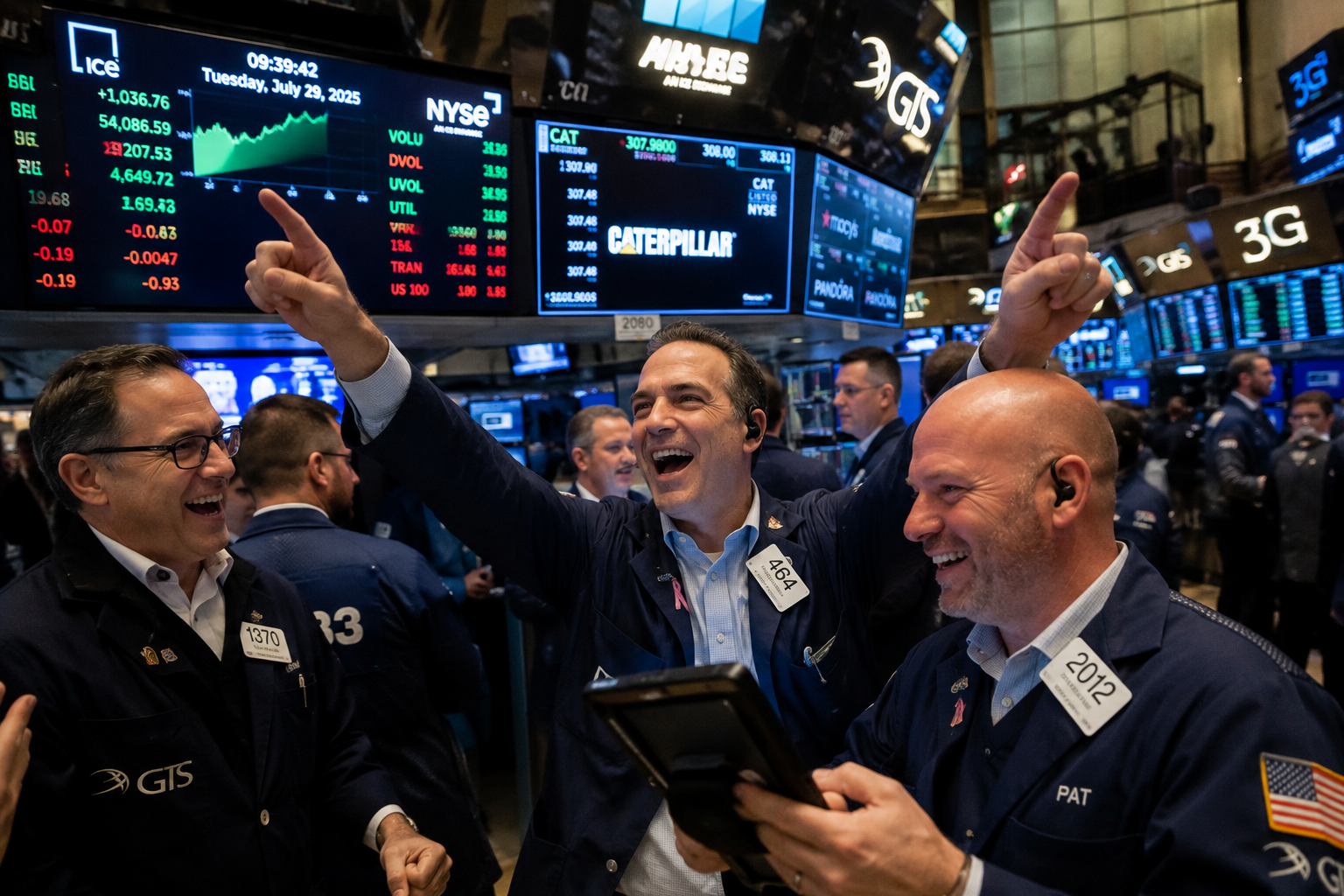
Wall Street added another record to an already remarkable summer.
The Dow climbed 907 points, or 1.7%, to a record 54,086. The S&P 500 gained 1.8% and the Nasdaq 100 jumped 3.3% as investors continued buying AI winners while falling oil eased inflation fears.
Tuesday's rally spread well beyond technology. Caterpillar (CAT) rose after beating earnings and raising guidance as AI data center construction continued driving equipment demand. More than 84% of S&P 500 companies have now beaten earnings expectations this season, giving investors confidence that corporate profits are still expanding despite higher rates.
Asia extended most of the move overnight. South Korea's Kospi gained more than 4%, Japan's Nikkei rose over 3%, while Hong Kong lagged as Chinese markets remained cautious.
The mood shifted slightly after the close.
SpaceX (SPCX) and AMD (AMD) both reported results that beat expectations, yet both stocks fell sharply after hours. Investors again focused less on revenue growth and more on the cost of building AI infrastructure.
Today keeps earnings busy. Eli Lilly (LLY), Novo Nordisk (NVO), Disney (DIS), Shopify (SHOP), Uber (UBER) and AppLovin (APP) all report before attention turns to Friday's payroll report.
The Signal
The rally continues, but investors are no longer rewarding growth alone. They want profitable growth.
The REAL Reason 2,000 Missiles Rained on Iran
Forget terrorism. Forget oil prices. Forget everything the evening news told you.
After two private meetings with U.S. Congressmen on March 2nd — and weeks of digging into what those conversations uncovered — I'm convinced we launched those strikes for a completely different reason.
If you have even a single dollar invested in the U.S. stock market, what I've found will directly impact you — starting August 12th.
Oil extended its sharp decline as optimism around Iran negotiations continued.
Brent crude settled at $79.36 after falling 5.3%, while WTI dropped 5.7% to $75.77. Treasury Secretary Scott Bessent said a framework to reopen the Strait of Hormuz could be reached within days.
Qatar confirmed an interim proposal has been drafted, while Iran continues discussions with Oman on shipping arrangements. Reports also suggest Tehran is considering allowing European teams to clear mines from the strait.
Markets welcomed the headlines.
Energy traders remain cautious because no agreement has been signed. Shipping traffic has not fully returned, and Hormuz remains the world's most important energy chokepoint.
Brent is now down roughly 10% this week, its biggest weekly decline in months.
Energy Signal
Oil is pricing diplomacy before diplomacy is complete. Until ships move freely through Hormuz, headline risk remains high.
Economic data continues sending mixed signals ahead of Friday's jobs report.
Job openings fell to 7.36 million in June from 7.54 million, suggesting labor demand is cooling. At the same time, ISM manufacturing rose to 55.6, well above expectations and its strongest reading in months.
The Federal Reserve remains caught between those two stories.
Chair Kevin Warsh held rates at 3.50% to 3.75% last week despite three officials voting for an immediate hike. Lower oil prices helped push the 10-year Treasury yield back toward 4.64%, but the 30-year remains near its highest level since 2007.
Friday's payroll report now becomes the week's biggest macro event.
A strong labor report strengthens the case for another rate hike. A weaker report would support the argument that higher rates are finally slowing the economy.
Macro Signal
Manufacturing improved. Hiring softened. Payrolls will decide which trend matters more.
Buffett, Gates and Bezos Quietly Dumping Stocks—Here's Why
The world's wealthiest individuals are making huge moves with their money.
Warren Buffett just liquidated billions of shares. Bill Gates sold 500,000 shares of Microsoft. Jeff Bezos filed to sell Amazon shares worth $4.8 billion.
What is going on? One multi-millionaire believes they are preparing for a catastrophic event. But not a crash, bank run, or recession. It’s something we haven’t seen in America for more than a century.
SpaceX and AMD delivered another reminder that AI investors are raising the bar.
SpaceX reported revenue of $7.8 billion, up 92% from a year ago, while losses narrowed sharply. Starlink revenue climbed 66%, and AI revenue more than tripled.
The concern was spending.
Quarterly capital expenditures reached $18.4 billion, including nearly $16 billion tied to AI infrastructure. Shares fell almost 7% after hours despite the revenue beat. Thursday's expiration of the company's 911.5 million share insider lockup adds another test for investors.
AMD posted similar results.
Revenue climbed 50% to $11.54 billion while data center sales more than doubled. Guidance topped expectations, but gross margins came in at 54% versus the 56% analysts expected as costs tied to new AI systems increased. Shares fell roughly 8% after hours.
The market is rewarding companies that prove AI spending creates profits. It is becoming less patient with companies asking investors to wait.
Capital Signal
Revenue beats still matter. Margins and returns matter even more.
Bitcoin remained steady while institutional demand improved.
The world's largest cryptocurrency traded near $64,300 as spot Bitcoin ETFs attracted more than $170 million in net inflows, their strongest day in several weeks. BlackRock's IBIT accounted for over $111 million of those purchases.
Strategy (MSTR) remained absent from the market.
The company has now gone six straight weeks without adding to its bitcoin holdings. Additionally, it disclosed that it had sold 1,638 BTC last week to strengthen its balance sheet. Michael Saylor continues expressing confidence in Bitcoin, but investors are watching actions more closely than words.
Meanwhile, pressure continues building in Washington.
Today is effectively the deadline for Senate leaders to move the CLARITY Act toward a possible vote before lawmakers leave for the August recess. Current estimates still place the bill's chances near one-third.
The Coldcard wallet exploit also continues expanding, with estimated losses now approaching $114 million across more than 5,200 affected addresses.
The Verdict
ETF money has returned. Strategy is waiting and selling. Congress remains the biggest uncertainty for crypto this week.
The Closest Thing to a Virtual AI Monopoly Wall Street Is Ignoring
A little-known company is building what may be the closest thing to a virtual monopoly the AI era has ever seen.
Only 3...
Yet it beat Apple, Amazon, and the S&P 500 combined...
While paying out $146,000 in total dividends on a 1,000-share stake.
Kevin O'Leary calls what it controls a "unicorn."
Right now, it's trading at a rare discount.
>>>Whitney Tilson reveals the name, completely free.<<<
This ad is sent on behalf of Stansberry Research, 1125 N Charles St, Baltimore, MD 21201. If you would like to optout from receiving offers from Stansberry Research please click here.
The market is entering the second half of earnings season with a much clearer scoring system.
Companies like Microsoft (MSFT), Amazon (AMZN) and Caterpillar showed that AI investment is already producing measurable revenue. SpaceX and AMD showed that investors now care just as much about how much that growth costs.
Oil is moving lower on hopes of diplomacy, but no agreement has been finalized. Bond yields remain elevated even as energy prices fall. Friday's payroll report now sits at the center of both stories because it will shape expectations for the Federal Reserve's next move.
This week's rally has pushed the major indexes back to record highs. Keeping them there will require more than strong headlines.
The market has already decided that AI demand is real. The next question is whether profits can continue growing fast enough to justify the price investors are paying.
