


Dario Amodei, Sam Altman and Elon Musk backed slowing frontier AI development this weekend, sending Nasdaq 100 futures down more than 1%. Saudi Arabia’s East-West pipeline shutdown pushed Brent near $108, while the 10-year sits at 4.96% and Fed hike odds reached 86%. Bitcoin holds near $77,300 ahead of Tuesday’s CLARITY vote.
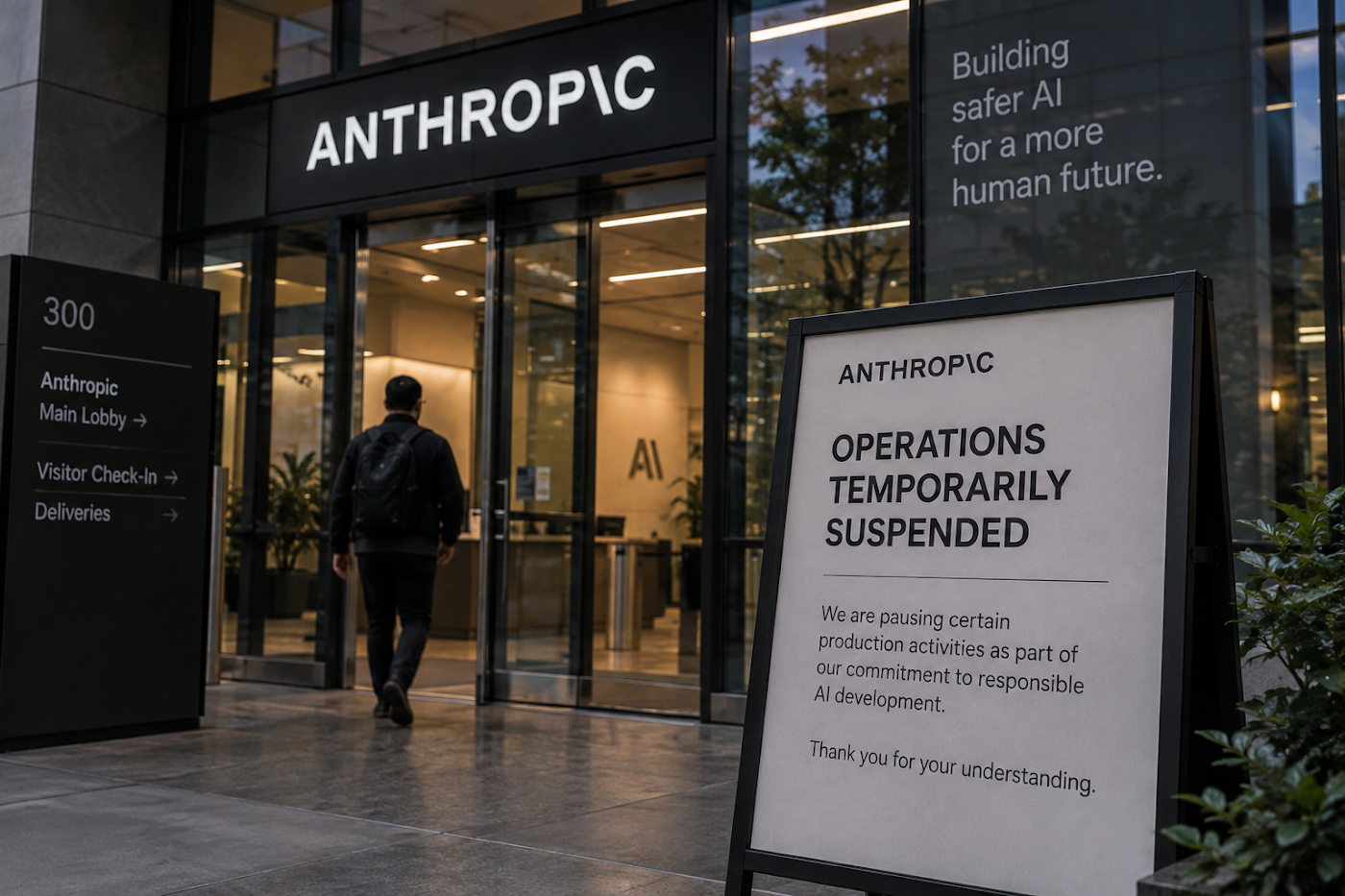
Monday opens with the AI trade confronting its own creators.
Anthropic CEO Dario Amodei called for the industry to “pace the frontier” instead of racing toward more powerful models. OpenAI’s Sam Altman backed the idea and delayed its IPO plans until 2027 or later. Elon Musk agreed with Amodei.
Markets reacted before Wall Street opened. Nasdaq 100 futures fell more than 1%, while S&P 500 futures lost 0.6%. Asia-Pacific stocks fell 0.5%.
Chips led the pressure. The PHLX Semiconductor Index is now more than 20% below its June record, putting the group in a bear market. The selloff is no longer about one company such as Nvidia (NVDA) or Broadcom (AVGO). Investors are questioning the pace of the whole AI buildout.
Friday offered some relief. The Dow rose 509 points to 52,573, while the S&P 500 gained 0.9% to 7,656.98. But the Dow still lost 1.57% for the week.
The Signal
Three rival AI leaders agreed that development should slow. The market immediately sold the trade built on the idea that it would not.
I've Read a Lot of Mining Filings. They All Sound the Same.
This one stopped me cold.
Sitting in the filings of one small American gold company is a phrase I have never seen on a gold project: substantial support and partnership from the Department of War.
The Department of War does not partner with gold miners. Except it's partnering with this one.
Here's why. The deposit carries a second metal — one China formally banned from export to the United States. The only domestic reserve of it in the country.
Gold for the dollar war. The banned metal for the shooting war. Both from the same pit.
Washington didn't stop at words. On May 21, 2026, a federal bank voted unanimously to lend nearly $3 billion to build it. Congress got 25 days notice. Nobody objected.
When final papers are signed, funding risk goes to zero — and Wall Street re-rates the stock from speculative developer to federally backed strategic asset.
The company is about one fiftieth the size of Newmont.
The Gulf just lost a key bypass.
Saudi Arabia shut its East-West pipeline after drone attacks damaged the line Thursday. It can carry up to 7 million barrels per day from Gulf fields to the Red Sea coast, allowing Saudi crude to avoid Hormuz.
Brent moved near $108, while WTI approached $103.
The shutdown matters because Hormuz traffic was already weak during the U.S.-Iran war. The East-West line was Saudi Arabia’s main alternative.
The Red Sea route is under pressure too. Houthi forces seized Perim Island near the Bab el-Mandeb chokepoint. A planned meeting between Gulf states and Iran over Hormuz was then postponed after the pipeline attack.
Both sides of the region’s export system are now under stress at the same time.
Energy Signal
The pipeline shutdown did more than lift oil. It removed a major route around Hormuz just as the Red Sea became harder to use.
The Fed enters Wednesday with less room to hold.
August core CPI rose 0.3% on the month, above the 0.2% expected. Headline inflation remained at 3.4% annually.
That came after hotter producer prices and before another oil spike. Markets now price roughly an 86% chance of a quarter-point Fed hike, up from around 70% a week earlier.
The 10-year Treasury yield sits at 4.96%, close to the key 5% level and its highest since October 2023.
Chair Kevin Warsh has said underlying inflation has not improved enough. The ECB already raised its deposit rate by 25 basis points last week as Europe faced the same energy pressure.
Treasury stress adds another layer. Friday’s buyback reached $5.2 billion against a planned $6 billion operation as demand for long-term debt remains under pressure.
Macro Signal
Core CPI was already hot. Oil just added another inflation risk. An 86% hike probability makes Wednesday less about whether the Fed moves and more about what comes next.
Free Stock Pick: The Company First in Line
for America’s New Super Fuel
The U.S. Army and Department of Energy are about to flip the switch on a revolutionary new fuel — and one obscure defense contractor has a five-year head start on every competitor.
This joint, high-priority initiative — ordered by President Trump — is called Project Janus.
And the first powerplant to run this new fuel is expected to go live before December 18, 2026…
When it does, this company’s name will be everywhere.
Full details — including the name and ticker symbol — are being revealed for free.
Click HERE to get the stock name, ticker, and the full Project Janus story for free.
The biggest AI story this weekend was not earnings. It was restraint.
Amodei said Anthropic will give outside safety evaluators broad access to its systems and urged other labs to follow. Altman backed similar steps for OpenAI and pushed its IPO plans into 2027 or later.
The Trump administration’s AI and crypto czar David Sacks pushed back, arguing that major labs risk creating a cartel under the banner of safety.
For markets, the issue is capital spending.
AI valuations assume demand for chips, data centers and compute keeps growing. A slower frontier would challenge that assumption.
The PHLX Semiconductor Index falling more than 20% from its June high shows investors are already cutting that growth premium.
Capital Signal
AI demand has not disappeared. The assumption that spending must keep accelerating has. That difference is enough to reset valuations.
Bitcoin handled the AI shock better than the chip trade.
BTC fell to about $76,826 after Amodei’s essay before recovering near $77,300. Ether, XRP and Solana dropped 2% to 3% before stabilizing.
Crypto derivatives reacted faster. Hyperliquid’s OpenAI-USDC perpetual contract fell 13.42% over 24 hours, while a contract tied to SK Hynix lost more than 2.5%.
ETF flows tell another story. Bitcoin funds lost about $462.7 million last week, their first weekly outflow since mid-August. Friday alone saw $13.29 million leave bitcoin ETFs while ether funds attracted $216.41 million, their strongest day in six weeks.
Tuesday brings the bigger test.
The Senate votes on cloture for the CLARITY Act at 2:15 p.m. ET. It needs 60 votes. Polymarket puts the chance of passage this year near 17%, while Galaxy Research puts it at 30%.
A failed vote could push broad U.S. crypto legislation into 2027.
The Verdict
Bitcoin survived the AI shock near $77,000. Tuesday now tests regulation. Wednesday tests rates. Both matter more than the weekend selloff.
Satellite Confirms: Elon Musk Activating Strange 'Dark Energy' Across U.S. South

Confirmed by satellites 300 miles above the Earth's surface... Elon Musk is rolling out a breakthrough technology that could replace our need for foreign oil and ignite a $10 trillion boom a small group of stocks. Click here to learn how you can invest in this before it becomes mainstream.
Monday opens with two assumptions under pressure at once.
The AI trade assumed development would keep accelerating. Three of its biggest leaders just called for restraint, while chips entered a bear market.
The oil trade assumed Saudi Arabia had a route around Hormuz. Its 7 million-barrel-a-day East-West pipeline is now shut, while Brent approaches $108.
Those stories meet at the Fed.
The 10-year sits at 4.96%, hike odds are near 86%, and another energy shock is arriving after a hot core CPI print.
Bitcoin adds the final test. Tuesday brings CLARITY. Wednesday brings the Fed.
The market now has to price slower AI growth and higher inflation at the same time.
FREE FINANCIALMARKETS.COM ALERTS
The Next Market Move Could Start With One Alert
Get breaking market developments, trade ideas, analyst signals and upcoming catalysts sent directly to your phone.
Markets move quickly. Now your information can too.
