AI suppliers beat and slipped, while SK Hynix and Seoul's market rallied.S&P 500 futures were about flat early Wednesday. Nasdaq 100 futures rose about 0.4%, and Dow futures fell about 0.2%. Seagate and Teradyne both beat and guided above forecasts, then fell. Seagate's revenue rose 61%. Teradyne's rose 70% to $1.31 billion, and adjusted earnings of $2.29 a share topped the $2.08 estimate. Seagate (STX) and Teradyne (TER) were quoted about 2% and 3% lower, respectively. NXP grew 8% from the prior quarter, but its forecast implies about 2%. Revenue of $3.79 billion beat the $3.76 billion estimate. NXP (NXPI) was quoted near $236, about 7% lower. SK Hynix beat on operating profit by about $4.7 billion, though net profit fell 58% from the second quarter. Its shares rose 10.9%, and the KOSPI jumped 6.6%. Visa's payments to banks and merchants grew faster than its revenue. Net revenue rose 13% to $12.14 billion, and client incentives rose 21%. Visa (V) was quoted about 1.6% lower. Microsoft (MSFT) and Alphabet (GOOGL) report tonight. Guidance Is the Grade Beating the quarter no longer buys the stock. Seagate, Teradyne and NXP all topped estimates and traded lower, even though Seagate and Teradyne guided above forecasts. SK Hynix rallied as investors focused on its operating line, even as net profit fell by more than half. The bar now sits above the beat, and a strong outlook alone has not cleared it. Premier Feature You've likely seen their faces on Fox Business, CNBC and Bloomberg. One is the economist who told his readers to sell everything a few weeks before Black Monday. The other has written up 50 stocks before they soared 1,000% or more over the past twenty years. They've never sat down together... until now. And what they're seeing in this market, they say could make or break your retirement. Watch their free briefing now, before it's taken offline. Two days of diplomacy discounts partly reversed in one night.Oil is back above $100, priced on a date rather than damage. West Texas Intermediate rose about 1.4% to near $101.30. Brent's January contract gained about 1.5% in early European trading, after a 1.7% drop Tuesday. Yemen's Houthis said Tuesday that a missile hit Saudi Arabia's Ras Tanura refinery. Saudi authorities have not confirmed a strike, and Brent still fell Tuesday after the claim surfaced. The newer report came overnight: The U.S. has told several Gulf countries to prepare for a short, intense campaign against Iran after the Nov. 3 midterms, The Wall Street Journal reported, citing people briefed. No official statement has confirmed it. Heating oil futures lagged well behind crude early Wednesday. A Calendar, Not a Crater Oil's new premium appears attached to a date, not to damage. The strike claim surfaced Tuesday, a day Brent fell, and crude rose after a report of a post-election timetable. Refined fuel did not lead the move, as a real hit to Gulf refining usually would. Traders appear to be pricing what may come after Nov. 3, not a confirmed loss of supply. One central bank waited out a fuel shock, and prediction markets moved their money to December.New Zealand held rates by one vote when markets expected a hike. The Reserve Bank kept its cash rate at 2.75% in a 4-3 vote, with three members backing a move to 3%. All members said tighter policy is likely to be needed. The kiwi fell about 75 pips. Half an hour earlier, Australia's monthly inflation rose to 4.3%, with housing the largest contributor. Its central bank meets next week. Europe's banks are tightening credit before the ECB meets. A net 9% of euro-area banks tightened standards on business loans. Demand fell, mainly on higher interest rates, the ECB said. Loans for AI infrastructure were the exception. The bet on a Fed hike fell to a nickel before Wednesday's decision. On Tuesday afternoon, one Kalshi trade of about 120,000 contracts sold the hike at 6 cents. Polymarket's no-change contract rose to about 95 cents. Kalshi priced a December hike near 79 cents. Chair Kevin Warsh speaks after the decision. The Fight Moved to December Central banks are reading the same fuel shock differently. New Zealand held by one vote while warning that tighter policy is likely, and Australia's inflation picked up days before its central bank meets. Europe's banks are tightening credit as higher rates feed through, the ECB said. Today's Fed decision is priced as a near-certain hold, so what Warsh signals about December matters more than today's rate. From Our Partners Satellite Confirms: Elon Musk Activating Strange 'Dark Energy' Across U.S. South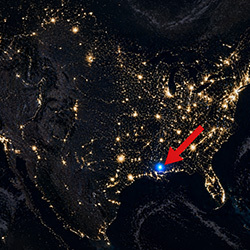
Confirmed by satellites 300 miles above the Earth's surface... Elon Musk is rolling out a breakthrough technology that could replace our need for foreign oil and ignite a $10 trillion boom a small group of stocks. Click here to learn how you can invest in this before it becomes mainstream. Bidders and owners split assets into pieces to raise money and keep control.Warburg Pincus topped Ingenia's rival bidder by pre-selling two businesses. Its non-binding proposal is A$5.45 cash a security plus up to 5 cents in distributions, 10 cents above AVID Property Group. Two co-investors would take its holiday parks and gardens businesses. AVID has until Nov. 1 to match. BCE is selling half of its cell towers to a pension fund for C$2.45 billion. La Caisse will own 49.9% of a new company with more than 5,000 Bell sites, valuing it near C$4.9 billion. BCE (BCE) keeps control and leases the capacity back. KKR closed its first continuation fund for private credit. KKR (KKR) drew more than $460 million of commitments, PitchBook reported. It holds assets of a $1.5 billion lending fund that finished raising in 2017. Slices Over Sales Private capital is pricing assets in parts. Warburg pre-sold two Ingenia businesses to outbid a rival, and BCE sold half its towers while keeping control. KKR moved an old credit fund's loans into a new vehicle instead of winding it down. Owners are trading pieces to buy time and keep control. Bitcoin edged higher into the Fed, and the news was about who holds what.Bitcoin traded near $81,400 and ether near $2,370. U.S. spot bitcoin funds took in about $176 million on Tuesday, a second straight day of inflows. Robinhood now earns more from prediction markets than from crypto. Revenue rose 12% to a record $1.42 billion. Crypto revenue fell 55% from a year earlier to $120 million, though it rose about 20% from the second quarter. Event contracts brought in $173 million, more than six times a year earlier. Robinhood (HOOD) was quoted near $87, about 8% lower. Coinbase (COIN) and Strategy (MSTR) report Thursday. A bitcoin treasury company says it hasn't been able to withdraw its coins since June. Datavault AI (DVLT) was to be paid about 1,328 bitcoin for a $150 million sale of shares and a warrant. The coins were credited to its account at Biconomy off-chain, not sent to a wallet it controlled. It will restate past results, and its shares fell 49.6% on Tuesday. Moody's gave Ripple's stablecoin an A2 rating. The grade covers RLUSD's reserves, which target 103% coverage, not Ripple itself. Bessent says agencies can do what Congress didn't on crypto rules. He said Treasury, the SEC and the CFTC can build a framework without the CLARITY Act. Nothing has been proposed. Proof Beats Price A coin on an exchange's books is not a coin in hand. Datavault booked bitcoin it could not withdraw, while Ripple's token earned a grade for the reserves behind it. Robinhood's revenue shifted from crypto trades to event contracts. Crypto's value is moving toward whoever can prove custody and keep customers, not just toward the coin. Partner Spotlight On December 10th, a powerful new law signed by President Trumpwill trigger a radical shift in America’s money system... When a small group of private companies — not the Fed — will perform a major mint of a new kind of money. And those who act before this new system fully kicks in could see gains as high as 40X by 2032. But those who fail to prepare will be blindsided by this sea change to the U.S. dollar. Go here now for the details — before the December 10th mint hits the market. Wednesday morning priced what comes next.Chip suppliers beat and still fell, and oil priced a date after the midterms. Fed bets looked past today to December, and in crypto, proof of custody counted for more than price. Rates Just Reset. Who Feels It First?On January 2, the 10-year Treasury yielded 4.19%. By September 30, it was 5.29%. Most of that move landed in a single quarter.
The bond market repriced and companies are starting to report it. Some companies earn from higher rates. Some pay for them. And each one runs on a different clock. We traced three of them, IBKR, WRB and FIS, in a new FREE Special Report:
Rates Just Reset. Who Feels It First? Who earns it fast. Who earns it slowly. Who pays. One has already reported. The other two report next, and the report tells you the exact line to check. We'll text the report straight to your phone. Get the Free Report by Text → |
|