


Wall Street suffered its worst session since July 29 as semis sank and the 30-year yield hit its highest since 2007. Brent held near $91 with Hormuz still constrained. Retail earnings fill the morning, but the Fed minutes at 2 p.m. are the day's main test.
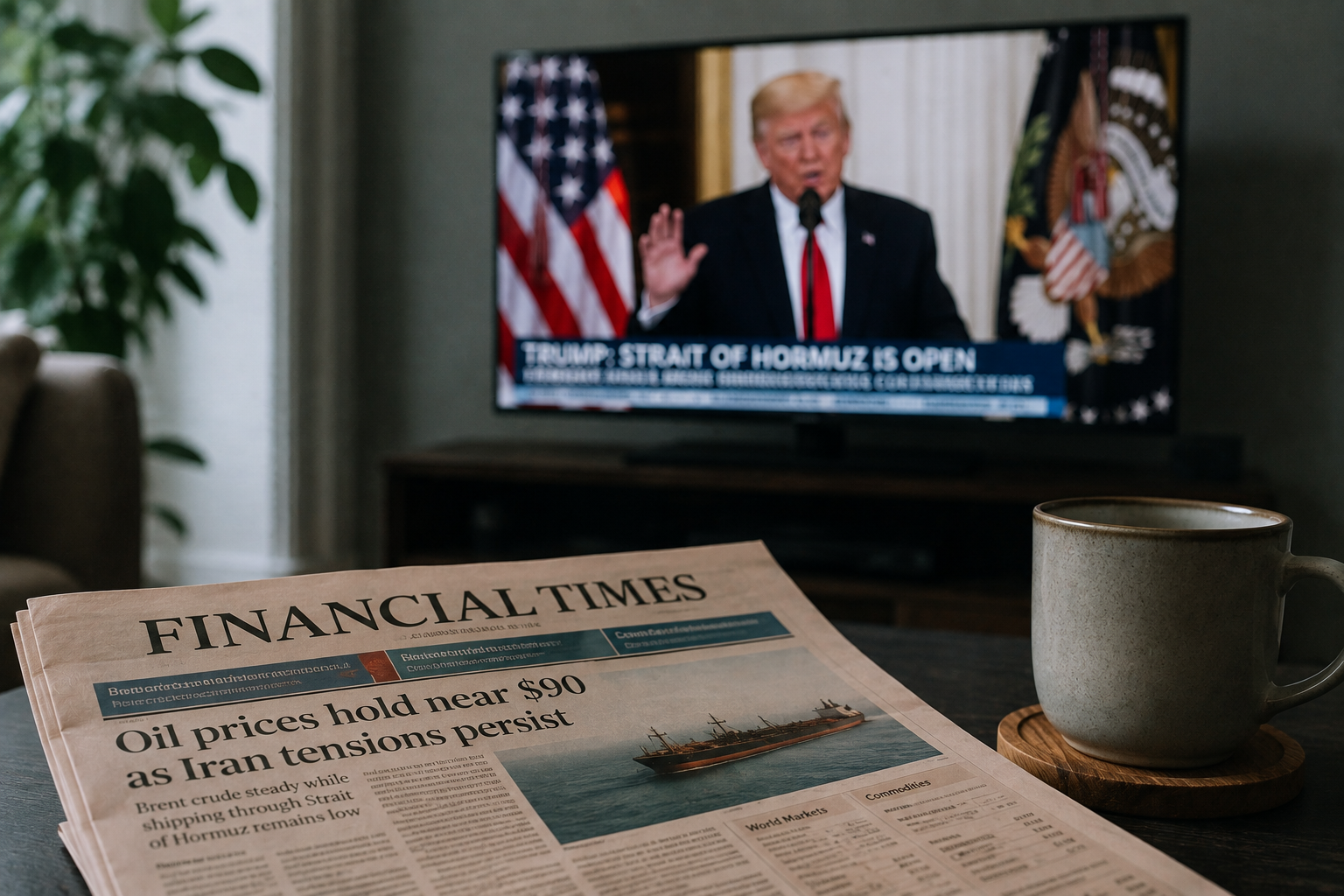
The chip selloff moved from Wall Street into Asia overnight.
The MSCI Asia Pacific fell 2%, while South Korea's Kospi sank 5.5%. Samsung and SK Hynix each lost more than 7%, and Kioxia fell 9% in Tokyo. Treasuries steadied, but futures pointed lower again.
Wall Street had already set the tone. The S&P 500 fell 0.69% to 7,691, the Nasdaq dropped 1.33% to 26,289, and the Dow slipped 0.22% to 53,343. It was the worst session for the S&P and Nasdaq since July 29. The Philadelphia Semiconductor Index sank 5.4%, with Nvidia (NVDA) down 2.3% and Micron (MU) off 7%.
The pressure came from bonds. The 30-year Treasury yield touched 5.33%, its highest since 2007, while the 10-year stayed near 4.70%.
TJX (TJX), Target (TGT), Lowe's (LOW), and Analog Devices (ADI) report today. Then at 2 p.m. ET, the Fed releases minutes from its July meeting, where three officials wanted a hike.
The Signal
Earnings matter today, but yields matter more. Every long-duration trade is being priced against a 30-year bond at a two-decade high.
Wall Street Doesn't Price Gold Mines. It Prices Labels.
Hang "speculative developer" on a company and the market discounts everything it owns. The gold can be real, the permits done, the shovels moving. The label says risk — so the price says risk.
Swap that label for "federally backed strategic asset" and the discount dies.
Only one thing kills a label: certainty. And certainty has a date.
On May 21, 2026, a federal bank voted unanimously to lend nearly $3 billion to build a gold mine on American soil. Congress got 25 days notice. Nobody objected. Final papers expected later this year.
Same deposit. Same permits. Same gold. But the day that ink dries — funding risk goes to zero, the U.S. government becomes financially fused to the project, and Wall Street re-rates the stock.
One more detail. This company's filings carry a phrase I've never seen on a gold project: substantial support and partnership from the Department of War.
Why? The deposit carries a second metal — one China formally banned from export to the United States. The only domestic reserve of it in the country.
Gold for the dollar war. The banned metal for the shooting war. Both from the same pit.
The company is about one fiftieth the size of Newmont. Still wearing the old label.
Oil stayed near recent highs as the U.S.-Iran standoff entered another month with no active talks.
Brent traded near $91 and WTI near $85, both up for a third straight session. Trump said Tuesday that Washington is not talking with Iran and has no talks scheduled, even as he claimed Hormuz is open and its mines have been cleared.
The traffic tells a different story. Only five commodity vessels crossed Saturday and none Sunday, versus 31 the weekend before. A vessel leaving Hormuz was also attacked, damaging its engine room and causing a crew casualty.
Iran fired two ballistic missiles toward the UAE, with Emirati defenses intercepting one while the other landed in its waters.
The response from producers is telling. Saudi Aramco has resumed offering crude through ship-to-ship transfers off Fujairah. Instead of waiting for Hormuz to normalize, suppliers are finding ways around it.
Energy Signal
The workaround is becoming the market. Oil is moving through side doors because the main one is still constrained.
The Fed minutes land at 2 p.m., but the bond market has already moved ahead of them.
The 30-year yield reached 5.33% Tuesday, while the 10-year held near 4.70%. Yet inflation expectations have not broken higher. Five-year breakevens remain near 2.25%, with the 10-year around 2.28%.
That makes this more than an inflation trade. U.S. government debt is approaching $40 trillion, and the market is demanding more compensation to finance it.
AI is competing for the same capital. Hyperscalers have issued $159 billion in bonds this year, up 47% from last year. Goldman Sachs expects issuance could approach $400 billion by year-end.
That is the backdrop for today's minutes. The Fed held rates at 3.50% to 3.75% in July, but three officials dissented in favor of a hike.
Macro Signal
The Fed is not only fighting inflation. Governments and hyperscalers are competing for the same long-term capital, and the price of that capital keeps rising.
The REAL Reason Trump Is Invading Iran

For a moment…
Forget about Trump’s ties to Israel.
Forget about reports of Iran’s nuclear program.
Because my research has led me to believe we’re risking World War 3 with Iran for a completely different reason.
Click here to find out what it is.
If you have even a single dollar invested in the U.S. stock market, this is going to directly impact you.
Retail earnings crowd into one morning.
TJX beat second-quarter expectations and raised its full-year profit outlook. Adjusted EPS came in at $1.22 versus $1.19 expected, while revenue reached $15.2 billion and comparable sales rose 4%. HomeGoods, TJX Canada and TJX International led the quarter with 6% to 7% growth, offsetting softer Marmaxx sales. Target, Lowe’s, and Analog Devices also report today.
Tuesday's retail read was mixed. Home Depot (HD) beat expectations, with adjusted EPS of $4.92 against $4.73 expected and revenue of $47.86 billion. Comparable sales rose 1.7%, almost twice the 0.9% forecast. But management kept full-year guidance unchanged as customers continued to avoid larger renovation projects.
The yield pressure is also reaching AI infrastructure. Cipher Mining (CIFR) fell 9%, TeraWulf (WULF) lost 7%, and HIVE Digital dropped 7% despite announcing a $350 million GPU cloud deal.
Long data-center contracts look less valuable when the risk-free rate keeps climbing.
Capital Signal
Retailers are testing the consumer. AI infrastructure is testing the discount rate. This week, the second test has been harder.
The SEC moved faster than expected.
Five days after canceling its planned vote, the agency issued its Regulation Crypto Assets proposal. Chair Paul Atkins called it a new course for crypto capital formation.
The proposal creates two exemption paths. Startups could conduct a one-time offering of up to $5 million, while another route would allow up to $75 million annually with added disclosures. Some tokens could also gain a safe harbor from securities rules once the issuer's managerial role is complete.
The proposal now enters a 60-day comment period. It arrives as Galaxy Research has cut its odds of the CLARITY Act passing this year to roughly 10%, down from 75% in May.
Bitcoin, meanwhile, remains just above $64,000. Gold has gained roughly 10% this month as long yields and fiscal concerns climbed, but BTC has stayed trapped in its summer range.
ETF flows show the same hesitation. Spot bitcoin funds lost $389.7 million in the week through August 14 after taking in $853.5 million the prior week. Monday then brought $297.6 million of inflows, ending a three-day outflow streak.
The Verdict
Washington finally moved on crypto rules. Bitcoin barely noticed. For now, the bond market is still setting the price of risk.
Buffett, Gates and Bezos Quietly Dumping Stocks—Here's Why
The world's wealthiest individuals are making huge moves with their money.
Warren Buffett just liquidated billions of shares. Bill Gates sold 500,000 shares of Microsoft. Jeff Bezos filed to sell Amazon shares worth $4.8 billion.
What is going on? One multi-millionaire believes they are preparing for a catastrophic event. But not a crash, bank run, or recession. It’s something we haven’t seen in America for more than a century.
Wednesday starts with the same pressure that ended Tuesday.
Semiconductors sold off in the U.S., then fell harder in Asia. The 30-year yield reached 5.33%, while AI firms and the government compete for long-term capital.
Hormuz remains constrained despite claims that it is open. Saudi Aramco is using transfers outside the Strait because waiting for normal traffic is no longer a plan.
Retail earnings will tell us how consumers are holding up. The SEC has finally put a crypto framework on paper. But neither is the day's main event.
At 2 p.m., the Fed minutes show how three officials made the case for a hike before long yields climbed this far.
The Fed controls the policy rate. Wednesday's question is how much control it still has over the price of long money.
