

The Nasdaq jumped 1.57% as Nvidia added roughly $440 billion in market value after earnings. Salesforce, Okta and CrowdStrike joined the AI rally. Qatar returned to Tehran to push a Hormuz framework, while Bitcoin held near $80,000 ahead of Kevin Warsh’s Jackson Hole speech Friday.
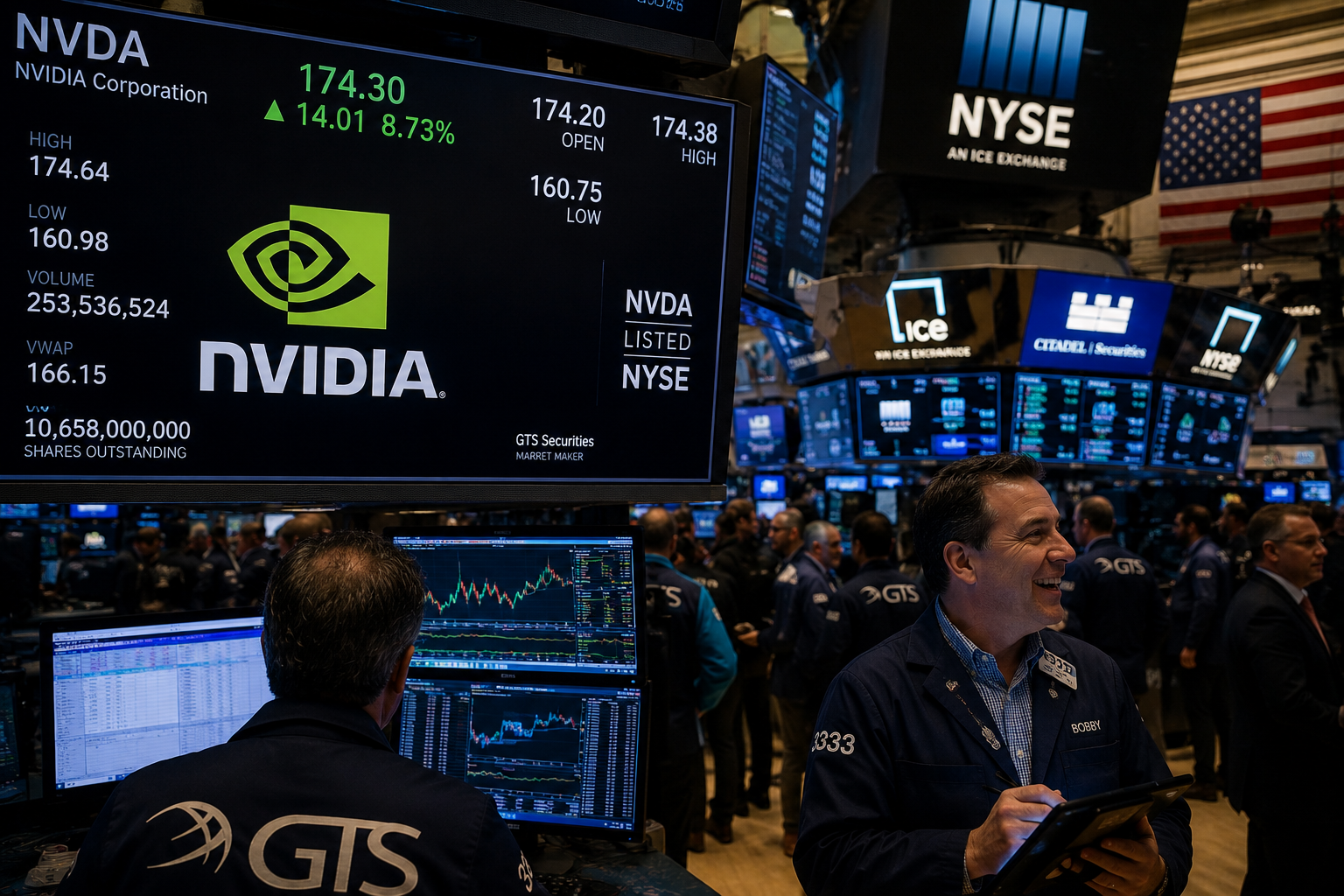
Nvidia gave the market the AI answer it wanted.
The Nasdaq rose 1.57% and the S&P 500 gained 0.72%. The Dow added 0.2%. It was the strongest session since August 4 for both the S&P and Nasdaq.
Nvidia (NVDA) jumped 8.7%, adding about $440 billion in market value after stronger earnings and guidance. Broadcom (AVGO) rose 4.5%, Intel (INTC) gained 4.4%, and the SMH semiconductor ETF climbed 3%.
The move spread beyond chips. Salesforce (CRM) surged more than 22%, Okta (OKTA) gained over 28%, and CrowdStrike (CRWD) jumped 20.5% as investors rewarded AI-linked software and cybersecurity demand.
Now the market moves from Nvidia to the Fed.
The Signal
Nvidia restored the growth trade. Warsh now decides whether the rate backdrop lets it keep running.
Markets Don't Reprice When a Mine Pours Its First Gold. They Reprice the Day Uncertainty Dies.
On May 21, 2026, a federal bank voted unanimously to lend nearly $3 billion to build a gold mine on American soil.
Congress got 25 days notice. Nobody objected.
Final papers expected before year's end. The day that ink dries, three things happen at once:
- Funding risk goes to zero
- The U.S. government becomes financially fused to the project
- Wall Street re-rates the stock from speculative developer to federally backed strategic asset
One more detail. This company's filings carry a phrase I've never seen on a gold project: substantial support and partnership from the Department of War.
Why? The deposit carries a second metal alongside its gold — one China formally banned from export to the United States. The only domestic reserve of it in the country.
Gold for the dollar war. The banned metal for the shooting war. Both from the same pit.
The company is about one fiftieth the size of Newmont.
Hormuz diplomacy moved another step forward, but the Strait remains leverage.
Qatar’s prime minister traveled to Tehran to meet Iranian Foreign Minister Abbas Araqchi and push talks on reopening the waterway. The plan under discussion includes a temporary Iran-Oman shipping corridor and joint mine clearing.
Iran says the Strait stays shut unless Washington meets conditions tied to the June ceasefire, including an end to the blockade, compensation and sanctions relief.
The White House says no formal negotiations are taking place and that all options remain open. Washington has also shifted its focus from military pressure to “Operation Economic Outcast,” aimed at Iran’s economy.
That leaves Qatar trying to bridge a gap neither side wants to publicly close first.
Energy Signal
The corridor talks are real progress. They are still not normal shipping. Hormuz remains a bargaining tool until vessels move without political conditions.
Friday is Kevin Warsh’s biggest communication test since taking over the Fed.
Inflation is still the problem. July PCE showed prices rising 3.7% from a year earlier, with inflation above the Fed’s 2% target for 65 straight months. Housing and utility costs remain firm, while some consumer goods are still rising quickly.
The Fed held rates at 3.50% to 3.75% in July, but three officials voted for a hike. Minutes showed that the hawkish view was broader than those three votes.
Warsh has avoided strong forward guidance since taking office. That approach becomes harder when Treasury is also trying to influence the long end through larger bond buybacks.
Economists expect him to signal that the Fed remains willing to hike if inflation does not cool. A speech that stays too vague could instead push investors to sell long bonds again, with some analysts warning the 30-year could move toward 5.5%.
Macro Signal
Warsh does not need to promise a hike. He does need to explain what would cause one.
The Closest Thing to a Virtual AI Monopoly Wall Street Is Ignoring
A little-known company is building what may be the closest thing to a virtual monopoly the AI era has ever seen.
Only 3...
Yet it beat Apple, Amazon, and the S&P 500 combined...
While paying out $146,000 in total dividends on a 1,000-share stake.
Kevin O'Leary calls what it controls a "unicorn."
Right now, it's trading at a rare discount.
>>>Whitney Tilson reveals the name, completely free.<<<
This ad is sent on behalf of Stansberry Research, 1125 N Charles St, Baltimore, MD 21201. If you would like to optout from receiving offers from Stansberry Research please click here.
Nvidia’s quarter bought the AI trade more time.
The company now expects fiscal 2028 revenue growth of 70%, far above the 44% analysts had expected. Jensen Huang said demand may be even stronger, but supply remains the limit.
Customer breadth also improved. AI cloud, industrial and enterprise customers generated $40.3 billion in quarterly revenue, up 138% from a year earlier.
That matters because the bear case was never only about demand. It was about concentration, circular financing and whether Big Tech could earn returns on massive data-center spending.
Thursday’s rally suggests investors accepted Nvidia’s answer for now.
The next risks are physical. Memory shortages, TSMC capacity and competing custom chips from hyperscalers could all limit how much of that demand Nvidia can serve.
Prediction markets are facing the opposite problem. Kalshi and Polymarket are scaling faster than the legal framework around them. New York and other states are challenging whether sports and event contracts belong under federal derivatives law or state gambling rules.
Capital Signal
Nvidia proved demand is broad enough to keep the AI buildout moving. Prediction markets now have to prove their legal structure is broad enough to support their growth.
Bitcoin held near $80,000 while traders waited for Warsh.
BTC traded around $80,000, while Ether rose above $2,500. XRP gained more than 5% and Solana jumped more than 12%.
BlackRock’s Robbie Mitchnick said the long-term case is shifting back toward a risk-off and store-of-value narrative. His argument is simple: debt, deficits and currency debasement can support Bitcoin even when equities and bonds struggle.
That fits recent flows. BlackRock’s IBIT now holds more than $76 billion in assets, while U.S. spot Bitcoin ETFs have taken in roughly $2.4 billion in August, their strongest month of 2026.
The policy backdrop is less clean. The CLARITY Act remains uncertain, and a new conflict-of-interest story around World Liberty Financial has pulled stablecoins, foreign capital and U.S. AI policy into the same debate.
A UAE-linked group reportedly owns 49% of the holding company behind World Liberty’s planned bank, while a Trump-family-linked entity owns another 38%. The structure is drawing scrutiny because the UAE is also seeking access to advanced U.S. AI chips.
The Verdict
Bitcoin is holding because the macro bid is stronger than the regulatory noise. Friday tests whether that bid survives Warsh.
On September 8th, a powerful new law signed by President Trump
will trigger a radical shift in America’s money system...
When a small group of private companies — not the Fed — will perform a major mint of a new kind of money.
And those who act before this new system fully kicks in could see gains as high as 40X by 2032.
But those who fail to prepare will be blindsided by this sea change to the U.S. dollar.
Go here now for the details — before the September 8th mint hits the market.
Thursday belonged to Nvidia.
Revenue growth, guidance and customer breadth turned the AI trade back on. Chips rallied. Software joined. The day became a vote of confidence in the spending cycle.
Friday belongs to Warsh.
He speaks with inflation still at 3.7%, a divided Fed, Treasury intervening in long bonds, and Bitcoin trading like a hedge against the same fiscal stress pushing investors into gold.
Hormuz adds one more layer. Qatar is trying to convert a temporary corridor into something lasting, but Tehran and Washington are still using the Strait as leverage.
Nvidia answered the growth question.
Warsh now has to answer the price of money.
