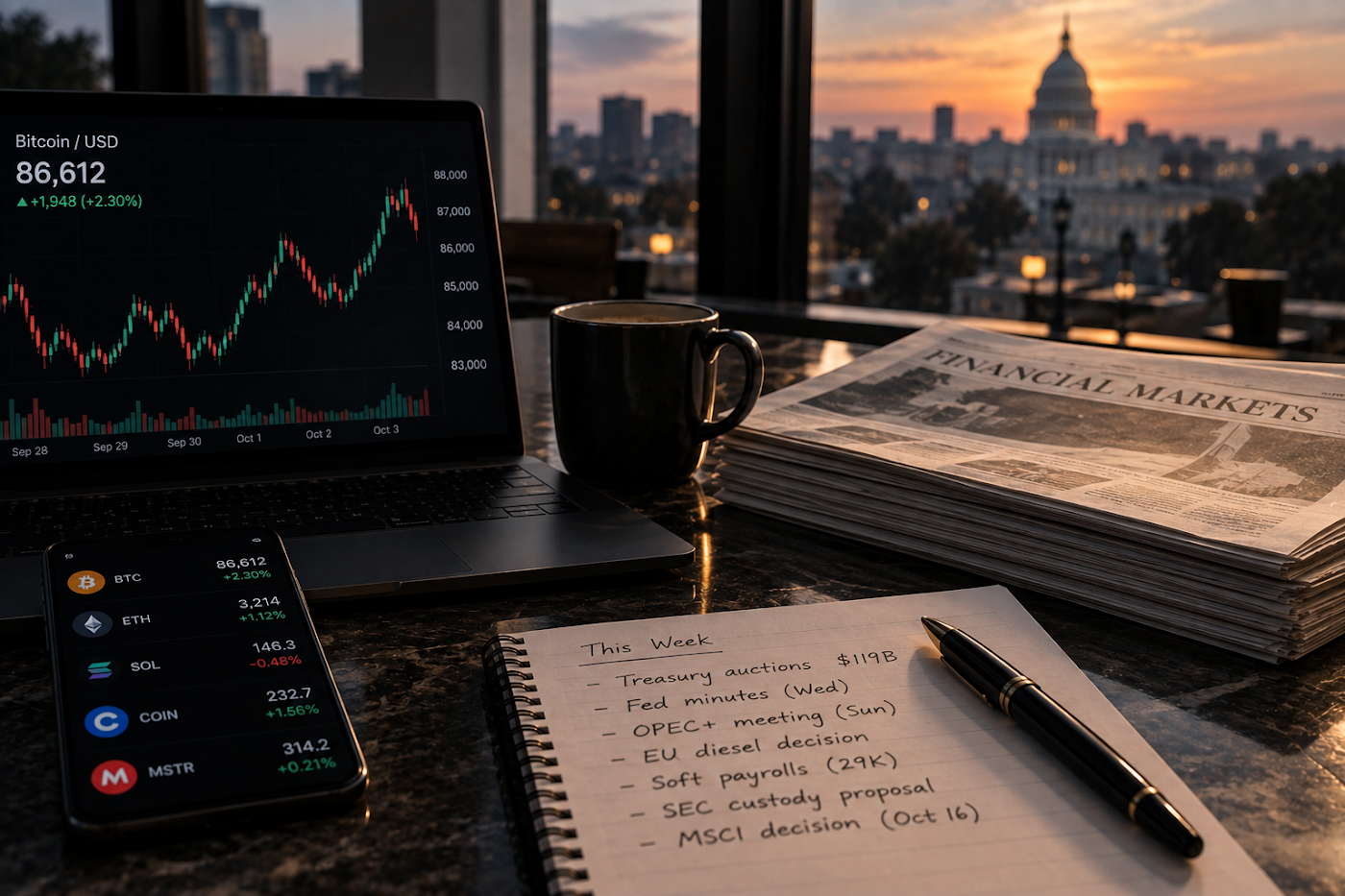
The biggest buyers took the week off. Bitcoin climbed anyway.U.S. spot bitcoin funds took in a net $51.2 million from Monday through Thursday, per Farside Investors. The same four days a week earlier brought in about $2.25 billion. Bitcoin traded near $86,600 at 9:57 a.m. Eastern Friday, up about 3% from the same hour a week earlier. The price moved with the rate market instead. Softer inflation on Wednesday and weak hiring on Friday cut the odds of an October Fed hike. The plumbing moved too, mostly on paper. Here are the six things that mattered. Premier Feature Your Mortgage Rate, Your Car Loan, Your Savings — All Rest on One Assumption.That the world keeps buying American debt. They stopped. China held $1.32 trillion in U.S. Treasuries at the peak. Today: $659 billion. An 18-year low. That money went into gold. Beijing's central bank has bought gold 20 months straight — its longest streak in a decade. Goldman Sachs put China's real buying at 4.8 times the official figure. And the European Central Bank just confirmed what hasn't been true in generations: gold has overtaken U.S. Treasury bonds as the world's #1 reserve asset. 27% gold. 22% our debt. The world's most conservative money isn't hedging the dollar. It's leaving it. When foreign buyers stop absorbing our bonds, rates rise, the interest bill eats the budget — and you feel it at the pump and the grocery store. Washington's counterattack is already signed, funded, and filed — with one small American gold company at the center of it. See Washington's counterattack here One Fund Carried the BidThe flows shrank and narrowed. Funds took in $31.0 million Monday and $66.2 million Tuesday. Wednesday brought a $148.7 million outflow, ending a nine-day run of inflows. Thursday added $102.7 million. That Thursday gain came from one place. The iShares Bitcoin Trust (IBIT) from BlackRock (BLK) took in $195.6 million. The other funds lost about $92.9 million. Ether funds lost money Tuesday, Wednesday and Thursday. Strategy (MSTR) raised about $246.2 million from stock in the week to Sept. 27, a Monday filing showed. About 58% bought 1,665 bitcoin. The rest bought back its own preferred stock below par. MSCI will rule by Oct. 16 on screening out companies like Strategy. Its own test run removed Strategy and Metaplanet. Funds tracking its indexes would have to sell any company it drops. A Narrower Floor The buyers behind the third quarter have thinned to a few names. One fund did Thursday's buying. The largest corporate buyer now splits its cash between coins and its own paper. An MSCI exclusion would add forced sellers on the other side. Bitcoin Traded the Fed's Next MoveBitcoin's best moves this week came when bets on an October hike fell. On Wednesday, core inflation ran 3.0% from a year earlier, under the 3.3% forecast. Bitcoin jumped to about $85,600 that morning. Then the 10-year Treasury yield rose past 5.30%, and bitcoin gave most of it back. On Thursday, the 10-year touched about 5.34%, its highest since 2002. By early Friday, Kalshi, Polymarket and CME pricing all put an October hike at 25% to 28%. Earlier in the week, all three had leaned toward a hike. Friday's jobs report pushed further. Employers added 29,000 jobs, against an 84,000 forecast in the Dow Jones survey. Unemployment rose to 4.2%. The 10-year fell to about 5.18%, and October hike odds dropped as low as 12%, Reuters reported. Bitcoin topped $87,000 that morning. Bitcoin closed the third quarter up more than 42%. Cheaper Money, Same Long Rates Bitcoin is pricing the Fed's path. Long yields are still near their highest since 2002. One good week does not prove the two have split. A hot inflation print would test which one bitcoin follows. From Our Partners This #1 stock for the next AI boom?
Behind the scenes, America's top AI scientists have been hard at work. They've been building a new category of AI-powered device so powerful… It'll trigger something AI scientists call an "intelligence explosion…" A sudden 360-fold acceleration in major AI-powered breakthroughs. That means it'd shrink AI breakthrough times from 3 years… down to 3 days. In the process, it's poised to spark a $100 trillion reset of the AI markets… starting THIS YEAR. That's why Louis Navellier believes this event could send certain AI stocks tumbling… While creating a new generation of AI millionaires and billionaires… Starting with the company he reveals here (down to the ticker) in his new presentation. This ad is sent on behalf of InvestorPlace Media at 1125 N. Charles Street, Baltimore, Maryland 21201. If you're not interested in this opportunity, please click here. A Two-Seat SEC Writes the RulebookThe SEC opened a new door to crypto on Thursday, with fewer people left to hold it. The proposal would give advisers and funds custody rules built for crypto. An adviser could hold client crypto itself when no eligible custodian exists. State trust companies could serve. Comments run 60 days after the plan appears in the Federal Register. Commissioner Hester Peirce, who leads the crypto task force, departs Friday. That leaves two members and three empty seats. Staff guidance shifts fast too. On Sept. 28, staff narrowed a token-buyback answer issued three days earlier. Congress offers no faster route. The CLARITY Act failed a Senate vote, 49 to 50, on Sept. 15. Faster, and Easier to Undo A two-member Commission can move quickly. Rules written that way, five weeks before the midterms, may face more legal and political risk. Advisers have reason to wait for a final vote before building around direct custody. Bitget's Fund Paid. The Chain Gave Back Almost Nothing.The exchange covered the theft. Recovery barely started. Bitget puts its loss at about $388 million. Customers pulled a net $463 million in the 24 hours into Tuesday. That was the largest one-day outflow for any exchange in four years of reserve tracking. Its protection fund fell below $200 million from $464 million. Bitget says it has refilled it above $300 million with its own capital. Tracing has frozen well under 1% of the loot. THORChain declined to block the attacker and let about $6.3 million of stolen ether swap into bitcoin. The final withdrawal phase was set for 08:00 UTC Friday. The Balance Sheet Was the Backstop The exchange took the loss with its own money. The chain gave little back. Customer safety rested on corporate capital, not recovery. The next test is whether withdrawals calm down once every service reopens. Partner Spotlight Buffett, Gates and Bezos Quietly Dumping Stocks—Here's Why 
The world's wealthiest individuals are making huge moves with their money. Warren Buffett just liquidated billions of shares. Bill Gates sold 500,000 shares of Microsoft. Jeff Bezos filed to sell Amazon shares worth $4.8 billion. What is going on? One multi-millionaire believes they are preparing for a catastrophic event. But not a crash, bank run, or recession. It’s something we haven’t seen in America for more than a century. For the full story, click here. Stablecoins Moved Into Bank SoftwareTwo deals put stablecoins inside banking systems that already exist. On Monday, Citigroup (C) and Coinbase (COIN) expanded a deal running both ways. Citi merchants can take stablecoins that turn into dollars on arrival. Dollars landing in Coinbase accounts become stablecoins. Neither firm named the tokens or a launch date. On Thursday, Fiserv (FISV) switched on its digital-asset platform for banks. The first use is the Bank of North Dakota's Roughrider Coin, running on Solana. More than 90 banks and credit unions can reach it. Fiserv has not shared volumes. Regulators missed the GENIUS Act deadline for final stablecoin rules. A Senate minority staff report traced 846 blacklisted Iran-linked wallets. It found 84% used USDT almost exclusively. Tether says it froze about $550 million of Iran-linked USDT this year. Distribution Ran Ahead of the Rules Banks are adding stablecoins through software they already run. Final rules are still unwritten. The Tether report adds compliance pressure at the same time. Volume figures will show whether this is real demand or a trial run. Leverage Gets a U.S. LicenseCrypto's favorite trade moved closer to home. Perpetual futures never expire, and most of that trading lives offshore. On Monday, the CFTC registered Coinbase's clearinghouse. Coinbase now owns the broker, the exchange and the clearing step. But the license covers only fully backed contracts. Margined trades still clear through outside firms. On Tuesday, Robinhood (HOOD) said it will offer perpetual futures to U.S. customers. Leverage would reach 10 times on bitcoin and ether. Trades would cost 1 basis point through year-end. It gave no launch date. Licensed, Not Yet Live The pieces for onshore crypto leverage are falling into place. The license stops short of margin, and Robinhood has no date. Until launch, the volume stays offshore. Just For You (Sponsored) The Closest Thing to a Virtual AI Monopoly Wall Street Is Ignoring
A little-known company is building what may be the closest thing to a virtual monopoly the AI era has ever seen. Only 3... Yet it beat Apple, Amazon, and the S&P 500 combined... While paying out $146,000 in total dividends on a 1,000-share stake. Kevin O'Leary calls what it controls a "unicorn." Right now, it's trading at a rare discount. >>>Whitney Tilson reveals the name, completely free.<<< This ad is sent on behalf of Stansberry Research, 1125 N Charles St, Baltimore, MD 21201. If you would like to optout from receiving offers from Stansberry Research please click here. The week pointed to where bitcoin takes its cues, for now. Not the ETF crowd, whose four-day haul shrank to a sliver. The Fed. Soft inflation and a weak jobs report cut October hike bets, and bitcoin rose as they fell. The structure kept moving on paper. A custody proposal, a clearing license, a perps plan and a bank stablecoin launch all arrived. Little of it is final or at scale. Bitget showed who pays when things break. The company did. Bitcoin showed it can rise on a quiet bid when rate bets ease. It has not shown it can hold that rise if they turn. 3 STOCKS OUR SIGNAL ENGINE SAYS TO WATCH CAREFULLY Three stocks. Three signals. Two weeks later, the story changed.On September 2, we published three market questions around KLAC, HPE and PG&E.
Two weeks later, every one of them produced new evidence. One company delivered record revenue and raised its outlook.
Another saw weakness spread across its entire peer group.
And in the third, a market risk that had only been showing up beneath the surface suddenly became explicit.
Yet none of these stories is finished. That’s why we built Market Tell.
To track the signals that keep moving after the headline is gone — and show you what investors should be watching next. We’ve put the latest analysis into a new FREE Special Report:
3 Stocks at a Major Turning Point See what changed… what still hasn’t been resolved… and the signals we’re watching now. Get the Free Report → |
|