


The U.S.-Iran memorandum expired with no extension as Hormuz traffic fell to three ships Sunday. Brent rose 2.7% to $90.87, the 30-year Treasury yield climbed above 5.31%, and Strategy raised its cash reserve to $4.8 billion without buying or selling bitcoin.
Monday put oil and long yields back in charge.
The pressure came from the U.S.-Iran standoff, not earnings. The June 17 memorandum expired with no extension, while Iran warned it could move from defense to offense if diplomacy fails.
WTI rose 2.6% to $84.50. Brent climbed 2.7% to $90.87. The 30-year Treasury yield moved above 5.31%, its highest level since June 2007, while the 10-year reached 4.72%.
AI still held part of the tape together.
Micron (MU) gained roughly 4%, while Broadcom (AVGO) and Nvidia (NVDA) rose on renewed optimism around Anthropic's growth.
That split is the day in one frame. Investors still want AI exposure. They just want it against a higher oil price and a more expensive long end.
The Signal
The AI bid is intact. The discount rate around it just moved higher again.
There's a Strategy Behind the Iran War.
I know because I've seen the evidence firsthand.
On March 2nd — three days after the first missiles hit — I sat across from two U.S. Congressmen in back-to-back private meetings.
Those meetings pointed me toward something I spent weeks verifying.
The real purpose behind the strikes. The real objective. And the single company at the dead center of all of it.
This isn't random. It's a calculated Two-Front Economic War.
And there's one company positioned right at the heart of it.
See the strategy behind the Iran war — and the company at the center of it
The sooner you understand what's really happening — the better positioned you'll be before August 12th.
— Dylan Jovine, Founder, Behind the Markets
The ceasefire path closed without opening Hormuz.
Both Washington and Tehran ruled out extending the June 17 memorandum. Iran says the U.S. violated the deal from the start. Trump says he has no interest in extending it.
Shipping remains near frozen.
Kpler counted only three vessels through Hormuz on Sunday. The five-day average is 12. Before the war, about 130 ships crossed daily.
Iran's position is also hardening. A senior official said Tehran could shift to an offensive posture if diplomacy fails. That could mean more pressure around Hormuz and across the region.
The market reacted fast.
Brent settled at $90.87 and WTI at $84.50. Bob McNally warned Brent could push back toward $100 if China increases imports.
Energy Signal
The deadline expired. Traffic did not recover. Oil is now pricing the chance that Hormuz becomes a military lever again, not a negotiating chip.
The front end still sees a Fed hold. The long end sees something else.
The 30-year Treasury yield climbed more than four basis points to 5.31%, its highest since 2007. The 10-year reached 4.72%, while the 2-year sat near 4.18%.
That matters because recent data argued for patience. Retail sales fell 0.6% in July. CPI and PPI both cooled. Markets have cut September hike odds sharply.
But long bonds are no longer trading only the Fed.
Oil is back above $90 Brent. Treasury issuance remains heavy. The fiscal deficit is large. AI infrastructure financing is also adding fresh demand for long-duration capital.
Three Fed officials voted for a hike in July. Wednesday's FOMC minutes now land against a curve that is saying inflation risk may be only one part of the problem.
Macro Signal
Short rates are pricing slower demand. Long rates are pricing oil, deficits and capital scarcity. That split is now the macro story.
Louis: The "Strawberry Problem" Is Stalling the AI Revolution

Billion-dollar tech investor Louis Navellier calls it "AI's darkest secret." Until AI models solve the "Strawberry Problem," they'll never create new breakthroughs in medicine, energy, or quantum computing. The good news? One company is about to solve the crisis… unleashing a new $100 trillion opportunity.
This ad is sent on behalf of InvestorPlace Media at 1125 N. Charles Street, Baltimore, Maryland 21201. If you're not interested in this opportunity, please click here.
Nvidia is moving from chip supplier to financier.
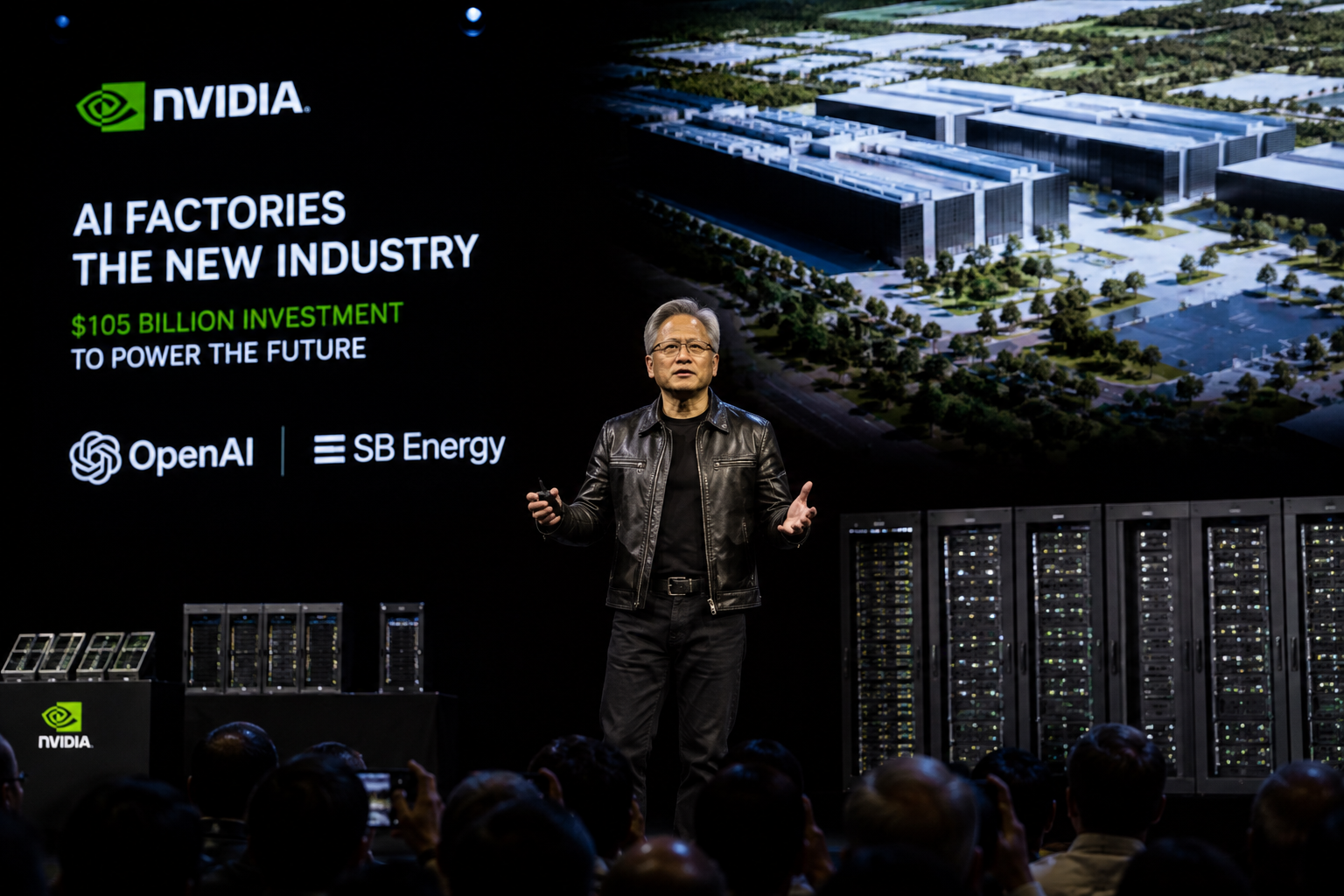
OpenAI signed a 20-year lease Monday for a 10-gigawatt data center in Ohio with SoftBank's SB Energy. Nvidia will backstop up to $105 billion of the completed asset value on the first 5-gigawatt phase and take equity in SB Energy through a $1.5 billion investment.
Nvidia gets exclusive chip provider status on the first half of the site. If OpenAI walks away, SB Energy would first try to re-lease or sell the site, with Nvidia paying any difference up to the backstop. The structure is a value guarantee on completed data centers, not project financing itself, which limits Nvidia's risk exposure.
The financing follows Nvidia's broader effort with firms such as BlackRock (BLK), Apollo (APO), KKR, Blackstone (BX) and Brookfield to mobilize up to $500 billion for AI infrastructure.
SEC staff guidance issued in July confirmed that certain data center debt structures do not qualify as asset-backed securities, exempting them from Dodd-Frank risk-retention rules.
That helps sponsors use more debt and less equity. It also makes the boom more leveraged.
Capital Signal
AI infrastructure is becoming its own credit market. More financing means more capacity. It also means more leverage underneath the same growth story.
Strategy (MSTR) did not buy bitcoin last week. It did not sell any either.
Instead, the company sold 3.46 million MSTR shares for about $333.7 million. Roughly $52.4 million funded STRC dividends, $132.2 million went to STRC repurchases, and $149.1 million increased cash.
That pushed Strategy's dollar reserve to $4.8 billion. Bitcoin holdings stayed at 840,447 BTC, worth about $53.4 billion against a cost basis of $63.4 billion. The average purchase price is $75,385.
The shift is becoming hard to ignore. Strategy is now managing equity issuance, preferred dividends, repurchases and index risk alongside bitcoin exposure. MSCI is reviewing whether treasury-heavy companies like Strategy belong in its global indexes.
Stablecoin regulation moved in the opposite direction. Treasury opened public comment on GENIUS Act rules that will govern when payment stablecoins are considered issued or sold in the U.S. The framework takes effect in January 2027, with tighter foreign-token rules following in 2028.
Bitcoin miners remain under pressure too. CleanSpark (CLSK) mined 586 BTC in July, down 5%. BitFuFu produced 112 BTC. Canaan mined 46 BTC. All three are leaning harder on balance sheets or AI infrastructure as mining output weakens.
The Verdict
Strategy is behaving more like a capital manager than a pure bitcoin buyer. Miners are becoming data center operators. Stablecoin rules are moving from law into implementation. Crypto's infrastructure story is getting more important than the spot price.
Ticker Revealed: Pre-IPO Access to the "Next Elon Musk" Company
We’ve found The Next Elon Musk… and what we believe to be the next Tesla.
It’s already racked up $26 billion in government contracts.
Peter Thiel just bet $1 Billion on it.
And you can get exposure — pre-IPO — through a 4-letter ticker symbol revealed in this free briefing.
Monday tied together three markets that had been trading separately.
Hormuz traffic fell to three ships. Brent crossed $90. The 30-year yield moved above 5.31%.
At the same time, Nvidia is helping finance the AI factories that create new demand for long-term capital, while Strategy is selling stock instead of buying bitcoin.
That is the common thread.
Oil needs ships. AI needs financing. Crypto needs balance-sheet discipline.
The ceasefire clock expired. The capital clock did not.
