


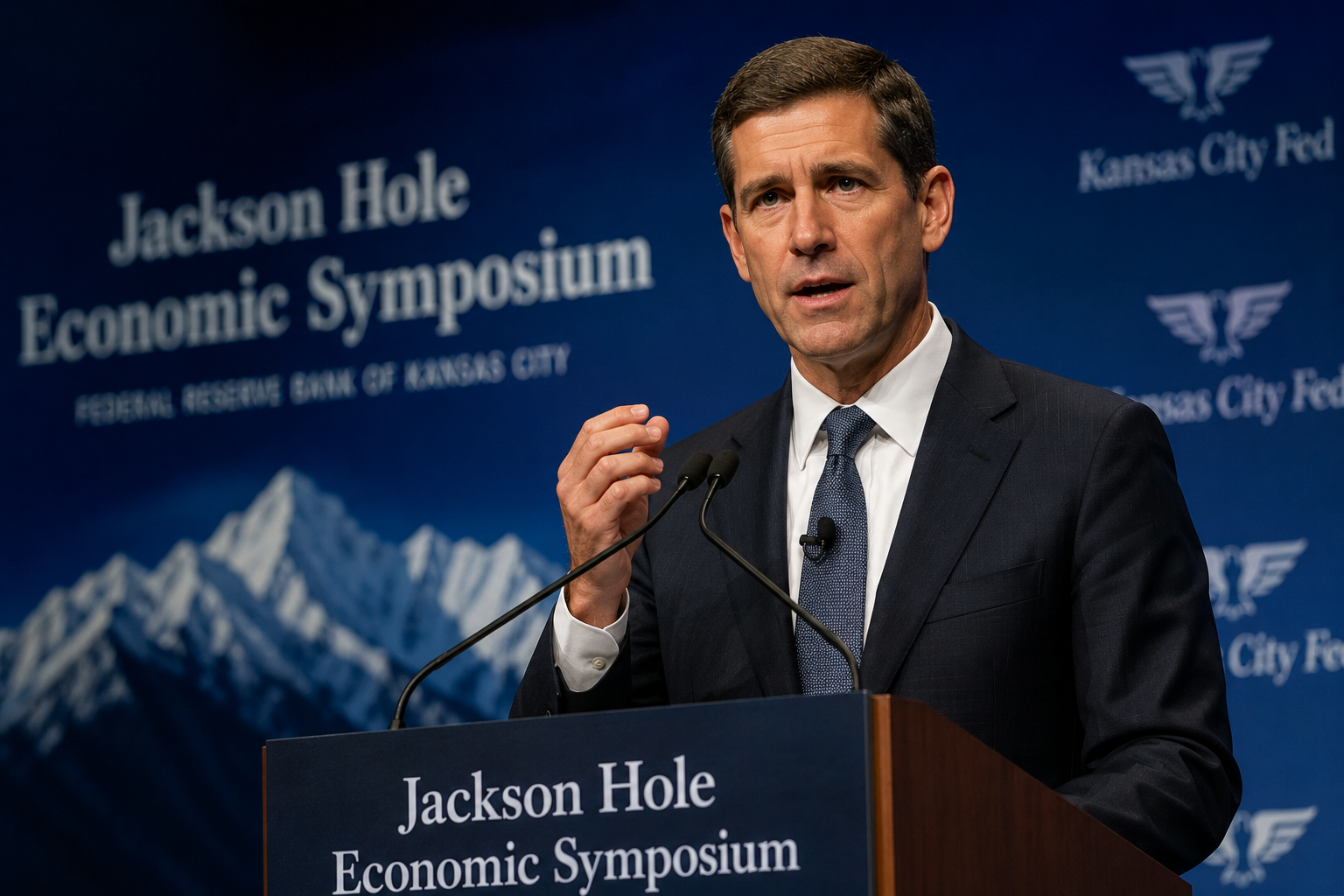
Kevin Warsh used Jackson Hole to warn inflation has not improved enough, pushing September hike odds toward 58%. The 2-year yield jumped to 4.35%, the dollar had its best day in months, and gold fell 3.2%. Bitcoin slipped below $78,000, while Hormuz traffic remained well below normal despite fresh diplomacy.
Friday belonged to the Fed, not Nvidia.
The S&P 500 fell 0.25% to 7,711.76, the Nasdaq lost 0.52% to 26,402.42, and the Dow slipped 9 points to 53,559.99. The Russell 2000 fell 1.39% as higher rate expectations hit smaller companies harder.
The week still finished higher. The S&P gained 0.5%, the Nasdaq rose 0.9%, and the Dow added 0.5%.
The turn came after Fed Chair Kevin Warsh said inflation has not shown enough improvement. Traders raised the odds of a September hike to about 58% from roughly 35% Thursday.
The 2-year Treasury yield jumped 11.8 basis points to 4.348%, its biggest one-day move since March. Nvidia (NVDA) fell more than 3%, while Marvell Technology (MRVL) dropped about 10%.
The Signal
Nvidia restored the AI bid Thursday. Warsh raised the price of money Friday. Growth still works, but the hurdle rate just moved higher.
Nuclear Stocks Are Surging — These 7 Lead the Pack
Nuclear stocks aren’t creeping higher — they’re breaking higher in waves.
Multiple names posted 40%+ gains last year as uranium prices climbed and plans emerged for hundreds of new reactors over the coming decades.
Producers are benefiting from rising uranium prices, while service providers are locking in long-term contracts and infrastructure spending adds another layer of demand.
Our analysts identified the companies positioned to benefit from multiple angles in a FREE report: 7 Top Nuclear Stocks to Buy Now.
Hormuz diplomacy improved again. Physical traffic did not.
Qatar continued efforts to reopen the Strait as Tehran said it is preparing conditions for a return toward normal shipping. Iran is still asking for sanctions relief, compensation and an end to the U.S. blockade on its ports.
Washington is moving in the other direction. The U.S. is expanding economic pressure and warning other countries against doing business with Iran. Tehran called the sanctions campaign economic warfare and urged governments not to comply.
Iran’s own inflation rate reached 66% last month, showing how much pressure is already building inside the economy.
Only seven commodity vessels crossed Hormuz Thursday, well below the 10-day average of 15. Before the war, roughly one-fifth of global crude moved through the Strait.
Crude slipped to about $83.44 Friday.
Energy Signal
Sanctions are replacing strikes, but Hormuz is still Iran’s leverage. Oil is pricing lower military risk before shipping has returned to normal.
Warsh stayed vague on timing. He was not vague on inflation.
He said the Fed still has work to do if inflation does not move toward 2% clearly and fast enough. He also said the economy appears stronger than expected, with solid spending, AI-related investment and labor weakness that may be more about worker supply than collapsing demand.
Markets heard a tightening bias.
September hike odds jumped toward 58%, while the 2-year yield reached 4.348%. The dollar index rose 0.59% to 99.69 and touched its highest level since August 17.
Gold took the other side of that move. It fell 3.2% to $4,504.10 as higher yields and a stronger dollar hit the debasement trade.
Warsh also used Jackson Hole to argue for a quieter Fed. He wants less forward guidance and said markets should not look to the central bank for their next trade.
That becomes harder when inflation has stayed above the Fed’s 2% target for 65 straight months.
Macro Signal
Warsh did not promise a September hike. He made one credible again. The market now needs one more jobs report and one more inflation print before September 16.
The REAL Reason Trump Is Invading Iran
For a moment…
Forget about Trump’s ties to Israel.
Forget about reports of Iran’s nuclear program.
Because my research has led me to believe we’re risking World War 3 with Iran for a completely different reason.
Click here to find out what it is.
If you have even a single dollar invested in the U.S. stock market, this is going to directly impact you.
Friday showed how quickly the AI trade changes when rates move against it.
Nvidia fell more than 3% after Thursday’s surge, while Marvell dropped about 10% despite higher revenue, profit and guidance. The reaction says the AI bar remains high even after a strong earnings week.
The broader inflation story also gained a new pressure point.
Wheat futures rose 3.1% Friday to 784 cents per bushel after touching 790.25, the highest since February 2023. Wheat gained 12.1% for the week and is now up more than 54% this year.
Russia and Ukraine account for more than a quarter of global wheat exports. Fresh attacks on Black Sea infrastructure and vessels are raising insurance and supply risks.
Corn settled at 536.5 cents per bushel, up 5.5% for the week and 21.8% this year after the USDA cut its yield estimate to 180.7 bushels per acre.
Capital Signal
AI valuations now have to absorb higher rates. Consumers may also have to absorb higher food costs. Both move the inflation debate in the wrong direction for risk assets.
Bitcoin ran directly into Warsh’s rate reset.
BTC fell about 3% to the $77,000 to $78,000 range after failing to hold above $81,000. Ether dropped to roughly $2,444, XRP slid 5% to $1.39, and Solana fell near $105.
The total crypto market lost about 2.2%.
The move was macro first. Higher short-term yields and a stronger dollar weakened the same debasement trade that had carried bitcoin higher over the prior week.
The structural bid has not disappeared.
Bitwise’s Solana Staking ETF, BSOL, crossed $1 billion in assets just 10 months after launch. It now holds more than half of all Solana ETF assets, even though the fund is down about 40% since launch and SOL remains roughly 60% below its record high.
Spot Solana ETFs have generated more than $13 billion in trading volume and about $1.7 billion in cumulative flows.
The Verdict
Warsh hit the price of crypto. He did not erase institutional demand. Bitcoin lost momentum, while Solana’s ETF growth showed capital is still moving into regulated crypto products.
Navellier Warns: This Could Leapfrog Elon's SpaceX IPO
Elon Musk could take SpaceX public in 2026, at an estimated $1.75 trillion valuation. The IPO would include Elon's AI model, Grok. But according to Louis Navellier, a radical new AI model will launch this year… over 1,000 times more powerful than Elon's. And the company behind it could outperform SpaceX in the process.
Click here for full details (including Louis' new pick — free).
This ad is sent on behalf of InvestorPlace Media at 1125 N. Charles Street, Baltimore, Maryland 21201. If you're not interested in this opportunity, please click here.
Friday reset the week without breaking it.
Warsh took September from a distant risk to a live meeting. The 2-year yield jumped, the dollar rallied, gold fell 3.2%, and bitcoin dropped below $78,000.
The message was simple. Inflation is still too high, and the Fed is not ready to declare the fight over.
That matters beyond rates. Wheat is up more than 54% this year. Corn is up nearly 22%. Hormuz traffic is still impaired. Each keeps pressure in the inflation pipeline.
At the same time, Nvidia’s earnings showed AI demand remains strong, and crypto ETF flows show institutions have not left the trade.
The week began with falling yields supporting risk.
It ends with Warsh reminding markets that lower rates still have to be earned.
